
Why Does a Wholesale Pajamas Order Act Like Two Garments Instead of One?


A pajama set is two garments counted as one product, so it carries two garments’ worth of cutting, sewing and matching risk while the price still gets compared to a single item. That’s why a 200-piece wholesale pajamas order can take 20-30 days after deposit and still come back with a top and bottom that don’t quite match. The set isn’t one thing. It’s a pair that has to agree.
I’m a merchandiser at a small women’s clothing factory in Baiyun District, Guangzhou. I follow orders from cutting through sewing to packing. I side with buyers on most arguments, but I also see where the factory gets stuck. Pajama sets are where both sides get stuck most often.
The sample that taught me this came back with the top and bottom in visibly slightly different shades. Not a dramatic difference. The kind you notice under daylight, then can’t stop noticing. The bulk order nearly repeated it.
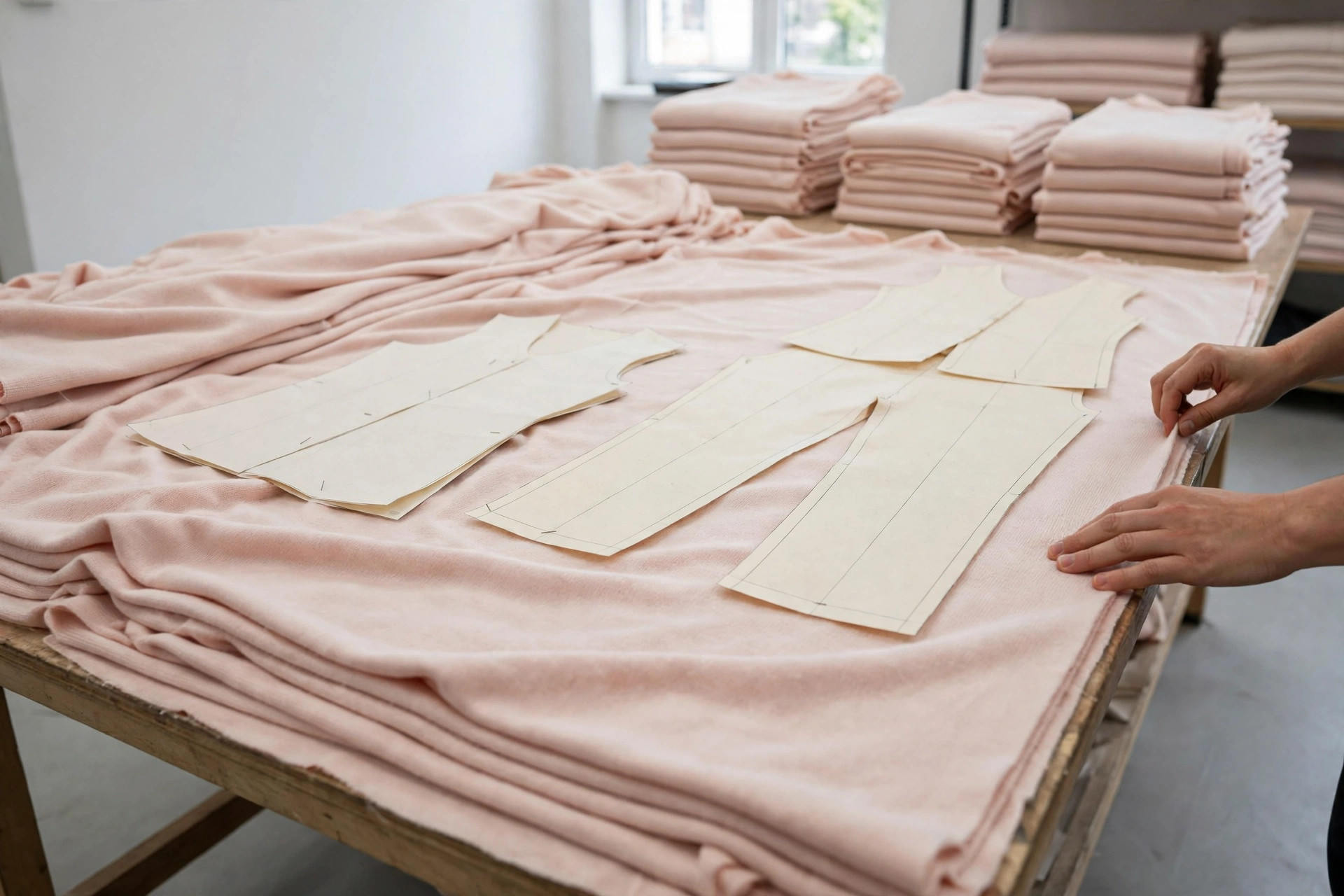
Why do the top and bottom of a wholesale pajama set come out in different shades?
Because they weren’t cut from the same fabric lay and the same dye lot. That’s the whole answer, and it’s the cause behind most shade complaints on wholesale pajama sets.
Here’s how it happens. A set needs, say, 1.4 metres for the top and 1.1 metres for the bottom. The cutter spreads the cloth in layers and cuts both pieces from that spread. If the fabric runs short partway through, someone pulls a second roll to finish the bottoms. The second roll looks identical on the table. It isn’t. Dye lots differ by a shade that the eye forgives in a folded stack and refuses to forgive on a body.
Pairing is the fix, and it’s a separate packing step dresses never need. It is the same matching problem that runs through how two-piece sets are put together for brands, except a pajama set adds a waistband that can twist and two pieces that can shrink apart. Before bagging, someone matches tops to bottoms from the same lay and the same roll. That’s an extra person, an extra table, extra time. If the bottoms run short of cloth, the whole set waits.
Nobody ships half a set.
No wait. That’s not quite fair to the cutter. Most of the time the lay is planned correctly and the shade gap comes from the fabric mill sending two rolls from different dye lots in the same shipment. The cutter catches it or doesn’t. Either way, the buyer sees the result.
What does MOQ mean when every colour is its own production run?
MOQ means minimum order quantity, the smallest number of pieces a factory will produce in one run. Here it’s 10 pieces per style, and sizes can be mixed inside one style. But every colour is its own production run. Ten pieces in two colours is two runs, not one.
Buyers hear “10 pieces” and picture a small, cheap order. Then they pick four colours and the math changes. Four colours means four cutting lays, four setups, four chances for a shade mismatch between top and bottom. The piece count stays small. The work doesn’t.
This is also where custom dyeing bites. Custom dyeing needs roughly 100 metres per colour. A thin colour run either uses stock cloth or pays the dye minimum. Most small wholesale sleepwear buyers choose stock cloth, which is fine, as long as they understand the colour is whatever the mill has, not whatever the screen showed.
Before bulk dyeing, there’s a lab dip: the small dyed swatch the buyer approves before the mill commits to the full run. Approve it under the light you’ll actually see the garment in. A lab dip approved under warm shop light and checked later under office light is a shade argument waiting to happen.
Why does the waistband elastic cause so many complaints after packing?
Because elastic has to be graded per size, and one elastic length across the whole size run means tight at the largest size and loose at the smallest. Grading means scaling a pattern across sizes. Elastic is part of that scaling, and it’s the part most often skipped.
Our size base is size S: bust 86 cm, waist 68 cm, hips 90 cm, and each step changes measurements by 4 cm. If the pattern is graded but the elastic length isn’t, the largest size gets a waistband that digs in and the smallest gets one that slides. Both are the same defect wearing different clothes.
Then there’s twisting. Elastic that twists inside its casing is a classic pajama complaint, and it shows up after packing and wearing, not at final inspection. On the table, the waistband looks flat. On a body, after two washes, the elastic has rolled inside the channel and the customer is annoyed. Nobody catches that at the end of the line because nothing looks wrong yet.
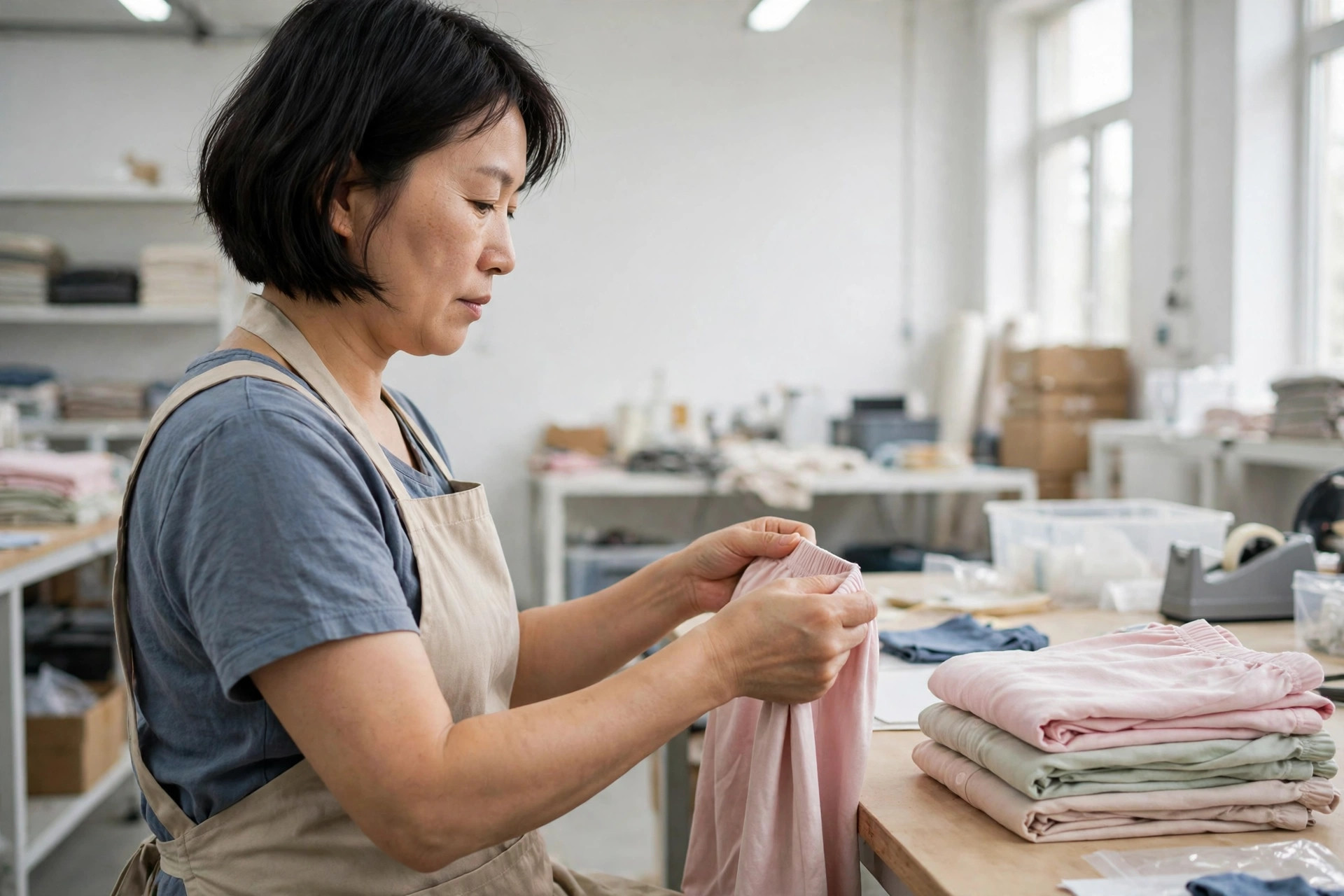
Does knit shrinkage explain a set that matched, then drifted apart?
Yes. Knit pajama cloth that wasn’t pre-shrunk shrinks about 3-5% on the first wash. A top and a bottom cut from two different rolls can shrink differently, so a set that matched on the table drifts apart after the customer’s first wash.
This is the quiet one. The buyer inspects the bulk, approves it, ships it, sells it. The complaint arrives three weeks later with a photo of a top that’s now a slightly different length and tone than its bottom. The factory says the cloth was fine. The buyer says the set is ruined. Both are telling the truth about what they saw.
Pre-shrunk cloth costs more per metre. Some buyers won’t pay it. That’s a real decision, and it’s the buyer’s to make. But it should be a decision, not a surprise.
Cloth weight matters here too. GSM means grams per square metre, the weight of the cloth. A lightweight knit at low GSM stretches and shrinks more readily than a heavier one. If a wholesale loungewear set feels thin in the sample, it will feel thinner after a wash.
Thin cloth tells on itself.
Where does cutting loss and inspection actually eat the margin?
Cutting loss is the cloth you buy that never becomes a garment, and it anchors at about 3% for plain cloth, 5-8% for checks that must be matched, and about 10% for prints. Those numbers are why a checked wholesale pajama set costs more than a plain one at the same piece count.
Checks have to match at the seams. That means the cutter positions the pattern to align the grid, and the leftover cloth between positions is waste. Prints waste more because the pattern repeat limits how tightly pieces can nest. Plain cloth nests tightly and wastes least. None of this shows up in a photo.
Inspection has its own anchor. Under AQL 2.5, a 200-piece order is checked on a 32-piece sample, with 1 major defect allowed. AQL means acceptable quality limit, the sampling standard that decides pass or fail. One major defect in 32 pieces passes. Two fails. That’s the rule, and it’s tighter than most buyers assume and looser than most factories wish.
And the last 20% of operations is where rushing does the damage on pajama sets: buttonholes, buttons, pressing, pairing, bagging. Press a set too fast and the top and bottom take different creases. Bag it too fast and the pairing check gets skipped. The first 80% of the work can be perfect and the last 20% still sends out a set that doesn’t match.
What should a buyer know before ordering wholesale pajamas in small batches?
Know that sampling takes 10-15 days and bulk takes 20-30 days after the deposit lands, and that the sample fee is $45-75 for a general style, with complicated styles priced from the photo. Half the sample fee is refunded when the order moves to bulk, once the bulk for that style passes 20 pieces.
Know that a factory like ours, GUANGZHOU SHIWEI APPAREL CO., LTD., is a small operation of 11-50 people in Baiyun District, and our SMETA 2-pillar audit was passed on 2026-08-03, run by Benchmarks, reference ZAA600220151. That audit covers labour standards and health and safety, not product quality. It tells you how people are treated, not how a waistband is sewn.
Know the boundary. A factory like this is the wrong choice for a buyer who needs single bottoms or single tops restocked separately every week, because sets are cut and paired as units. If your business model is separates, find a factory that runs separates. Don’t ask a set factory to pretend.
If you want satin-look pajamas, ours are polyester satin, not real silk. Say so in your listing. Buyers who expect silk and receive polyester satin don’t come back, and they tell people why.
Custom design is a different conversation with different minimums and timelines. This article is about buying ready styles in small batches, which is what most first orders should be. If you want to see the ready end of it, the ready styles currently listed in the wholesale catalog show what a factory sews from when nobody is starting from a blank page.
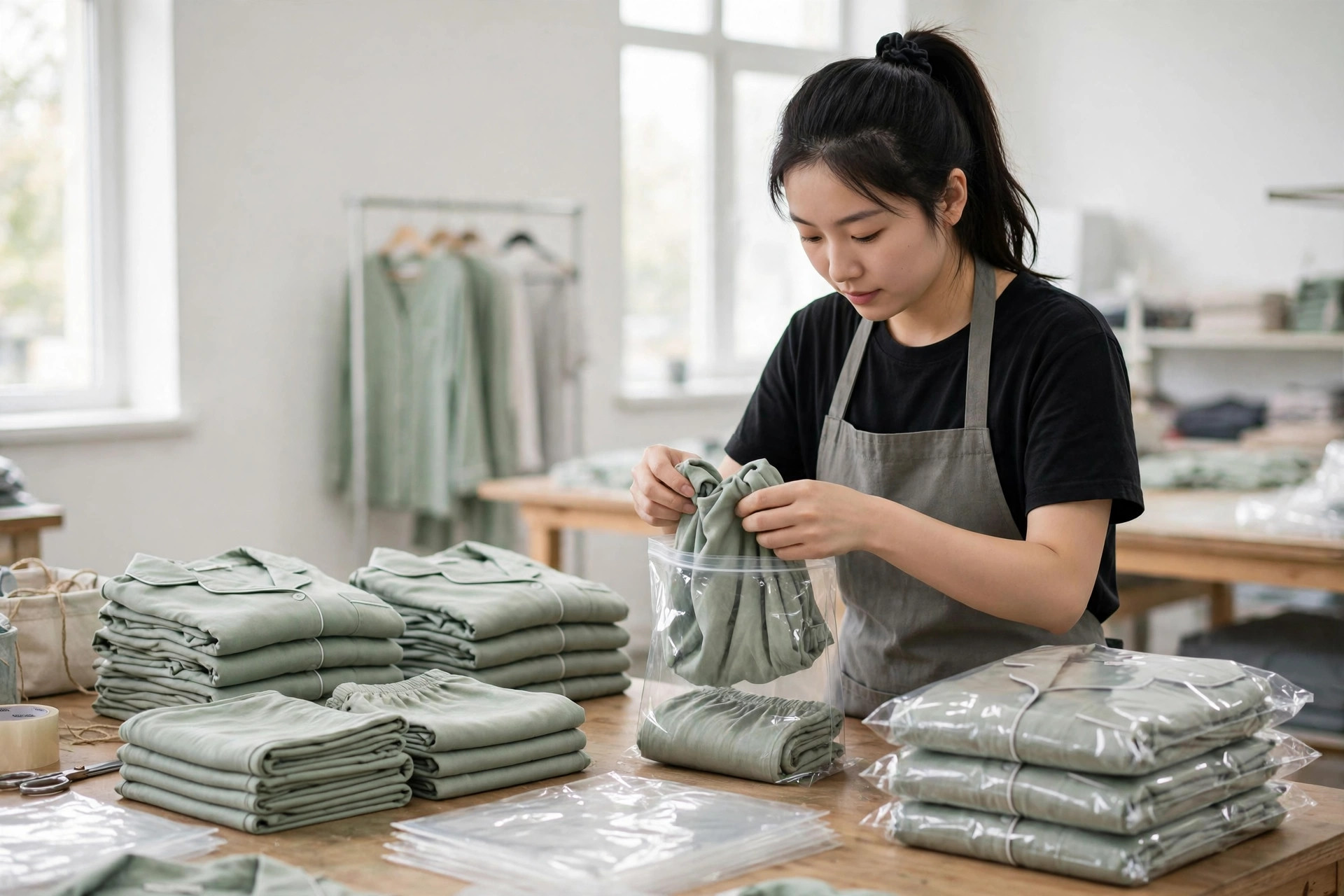
If I order 10 pieces in 3 colours, how many production runs am I actually paying for?
Three runs. MOQ is 10 pieces per style, and every colour is its own production run, so a colour cannot borrow pieces from another colour to reach the minimum. Ten pieces in each of 3 colours is 30 pieces and 3 separate cutting lays, 3 setups and 3 pairing checks. That is why a small multi-colour order quotes higher per piece than a single-colour order of the same total. If the budget is tight, fewer colours at the same total piece count usually gets a better price and a faster bulk slot.
My sample fee was $60 for a general style. What do I get back if I place a 200-piece bulk order?
You get half back, so $30, credited on the bulk invoice. The condition is that the bulk order for that style passes 20 pieces, and a 200-piece order clears it easily. Sample fees run $45-75 for a general style, and complicated styles are priced from the photo because the work cannot be estimated without seeing it. Ask for the refund to appear on the bulk invoice rather than as a separate transfer, because separate transfers get forgotten on both sides.
If my 200-piece order is inspected under AQL 2.5, how many defective pieces fail the whole batch?
Two major defects in the 32-piece sample fails the batch. Under AQL 2.5, a 200-piece order is checked on a 32-piece sample with 1 major defect allowed, so the second major defect tips it over. Minor defects are counted separately and don’t fail the inspection the same way. If the batch fails, the factory reworks or re-inspects, and that time comes out of your delivery window. Ask what counts as major before the inspection, because the definition decides the outcome more than the number does.
My knit pajama set shrank after the first wash. Is 3-5% shrinkage normal if the cloth wasn’t pre-shrunk?
Yes, about 3-5% is normal for knit pajama cloth that wasn’t pre-shrunk, and it’s the reason a set can match on the table and drift apart after washing. A top and bottom cut from two different rolls can shrink at different rates, so the gap opens between them rather than within one garment. Pre-shrunk cloth costs more per metre and reduces this. If you sell to customers who wash before wearing, which is most of them, budget for pre-shrunk cloth or warn buyers in the listing. Either way, decide before the bulk order, not after the complaints.
The pairing table is still set up from last week’s run, two stacks of tops and two stacks of bottoms, and the girl matching them holds a top against a bottom under the window and puts it back on the other stack. She’s been doing it for an hour. The shade is close enough that I can’t tell from here whether she’s right, and the buyer wants an answer today about whether the next colour can ship before the holiday. I don’t have one yet.


