
Why Does Wholesale Activewear Come Back See-Through, Rolling, or Bursting When the Sample Looked Fine?


Because the sample was never worn the way the customer wears it. A folded swatch held in an office tells you almost nothing about a legging under full squat stretch, and that gap between the sample table and the gym floor is where most of my return messages are born. Here is the number I keep coming back to: womenswear returns run about 15-25%, and the main cause is fit, not workmanship. Read that again, because it rearranges the whole complaint pile. Most of what lands in my inbox is not a factory that cannot sew. It is a buyer and a factory who both approved a sample under conditions the end customer never repeats. I sit on the consumer side of a women’s clothing factory in Baiyun District, Guangzhou, so I read the return reasons and the angry messages all day. I side with the buyer almost every time. But I also see exactly where the factory gets stuck, and it is rarely where the buyer thinks.
Why does a solid sample go sheer in the gym?
The first message of the week usually starts the same way. A buyer asks, is it squat-proof? As if squat-proof were a fabric name, like cotton or polyester, something you could order by the metre. It is not. Opacity is stretch-dependent. A legging can look completely solid while someone stands still in front of a mirror, then go sheer the moment the cloth stretches over the hip and the knee at the bottom of a squat. The same fabric, same dye lot, same roll. Nothing changed except the amount of stretch, and stretch is what thins the cloth. The order behind that question was small, 10 pieces per style with the sizes mixed inside the style, which is the minimum we run, and every returned piece from it arrived in my inbox as its own separate argument.
GSM is the term that gets thrown around here, so let me define it plainly: grams per square metre, the weight of one square metre of cloth. It sets the starting point for how much body the fabric has. A heavier GSM generally starts denser. But GSM alone does not promise opacity, because the same cloth at high stretch thins out. A 220 GSM knit stretched 40% across the hip is not the same material as a 220 GSM knit lying flat on a table. Buyers quote GSM like it is a guarantee. It is a starting point, not a promise.
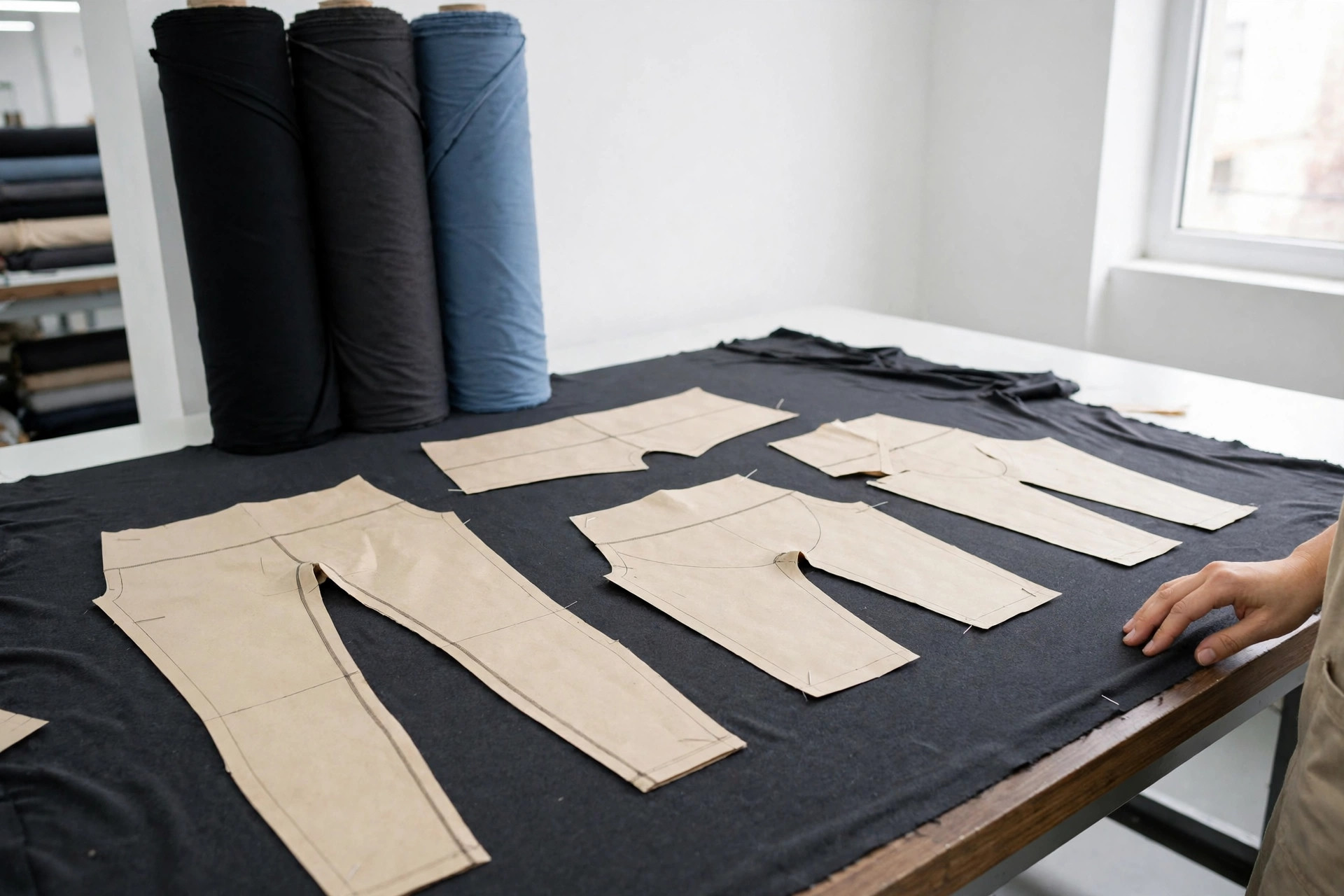
So what is the honest test? Worn, bent over, in daylight. Not a swatch held up against an office window. Not a photo taken under warm indoor light where everything looks opaque. I have watched buyers approve a sample in a meeting room and then get a message three weeks later saying the leggings are see-through in the gym. Both things were true. The sample was fine standing still. The product was not fine at full stretch.
Standing still proves nothing.
No wait. I should be fairer to the buyers here. Nobody teaches you to squat in a sample. The sample process itself encourages the wrong test, because you are handed a neat folded piece and you look at it, you feel it, you check the stitching, and it seems solid. The factory is not hiding anything either. The cloth really is that weight. The failure only appears under conditions nobody recreated in the room.
So why does the waistband roll if the sewing is fine?
The second complaint cluster is waistband roll, and this one gets misreported almost every time. The message says the waistband rolls down when I sit. It never says the casing is too wide. But that is usually what happened. A narrow elastic floating inside a wide casing has room to fold over itself the moment the wearer sits and the waist creases. The elastic twists, the casing folds, and the whole band rolls. A wider elastic fills the casing and has less room to turn. A topstitch through the casing pins the elastic in place and stops most of the rest. Both fixes are pattern decisions, made before anything is cut. They are not sewing defects, and no amount of re-stitching saves a casing that was drafted too wide for its elastic.
This is where I see the factory get stuck. The complaint arrives worded as bad sewing, so the buyer asks for better sewing. The factory re-sews. The roll comes back, because the pattern was never the conversation. By the time anyone says the word casing, the run is finished and the returns are already moving.
What do the seams have to do with wholesale activewear complaints?
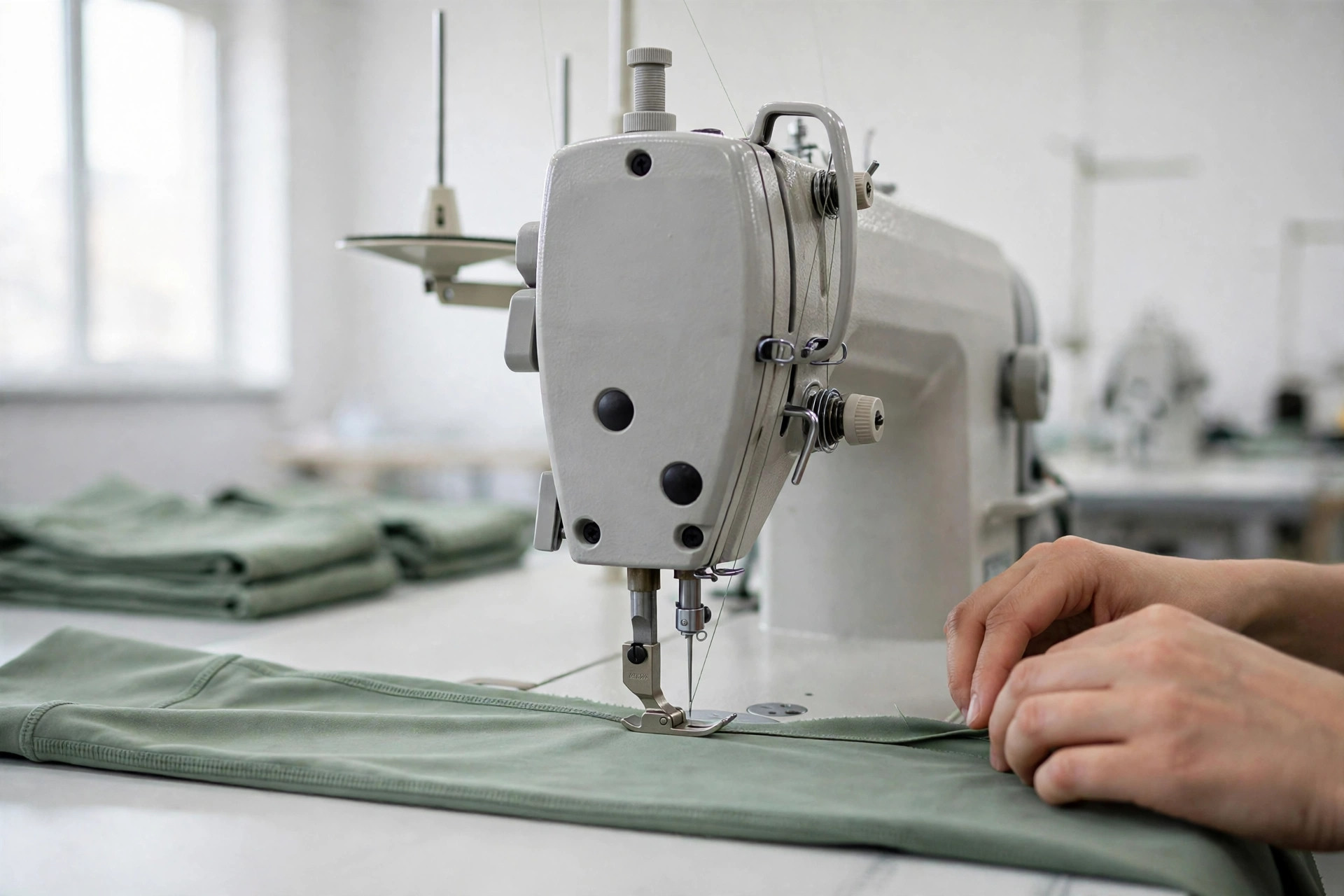
Seams decide the comfort complaints, and they split into two very different problems that buyers often merge into one. A raised overlock ridge rubs skin on long wear. Flatlock sits flat against the body, but it takes longer to sew and costs more per piece. That is a real trade-off, not a corner anyone is cutting quietly. The other problem is the crotch. A small diamond gusset at the crotch spreads squat stress across a panel instead of concentrating it on one seam line. Without it, the crotch seam is exactly where burst complaints cluster. When a buyer tells me the leggings burst, I ask where. If the answer is the crotch, I already know the pattern had no gusset, or the gusset was too small to do its job.
Pilling between the thighs is a different animal entirely. That is abrasion, and it follows the yarn, not the sewing line. You can re-sew a seam. You can re-sew a seam.
You cannot re-sew a yarn.
If the cloth pills under friction, the fix lives upstream, in how factories choose materials in the first place, and by the time the complaint arrives the fabric decision is long locked.
Why do the sizes drift when the chart looked right?
Now the part buyers rarely hear from a factory floor. Stretch cloth is graded with negative ease, which means the pattern is drafted smaller than the body on purpose so the fabric stretches to fit. Grading, plainly, is how a pattern scales from one size to the next. Copy a woven size chart onto stretch cloth and the sizes drift, because a woven chart assumes the garment hangs and a stretch garment grips. Our base here is S equals bust 86, waist 68, hip 90 cm, plus or minus 4 cm per size step. That base only works if the pattern was drafted for stretch in the first place. Copy it onto a woven block and the fit complaints start before the first wash.
Which brings up shrinkage. Un-pre-shrunk cloth can shrink 3-5% on first wash. On a fitted legging, 3-5% is the difference between snug and unwearable. Fabric should be inspected within 24 hours of arriving at the factory, because shrinkage and hand-feel problems caught late cannot be designed around. And on the inspection question, AQL 2.5 on a 200-piece order means sampling 32 pieces and allowing 1 defective. That is the standard most buyers accept without reading it closely. One defective in 32 sampled pieces is allowed. If your customer happens to receive that one, the return message reads like a catastrophe, and from their side it is.
Who should not buy wholesale activewear from a factory like this?
Here is where I have to be honest about who should not buy wholesale activewear from a general women’s factory like this one. If you need certified technical compression gear, or a licensed branded performance yarn with the paperwork to prove it, that is a specialist factory’s job. A general women’s factory can make a solid ready-style legging. It cannot pretend to be a performance lab, and buyers who need lab-grade claims should not be shopping here. The honest starting point is what is actually on the rails in the current wholesale catalog, not a promise in a message thread. One short contrast only: this is a wholesale ready-styles operation, not a custom-design house, so the patterns and fabrics on offer are the ones that exist, not ones invented for you.
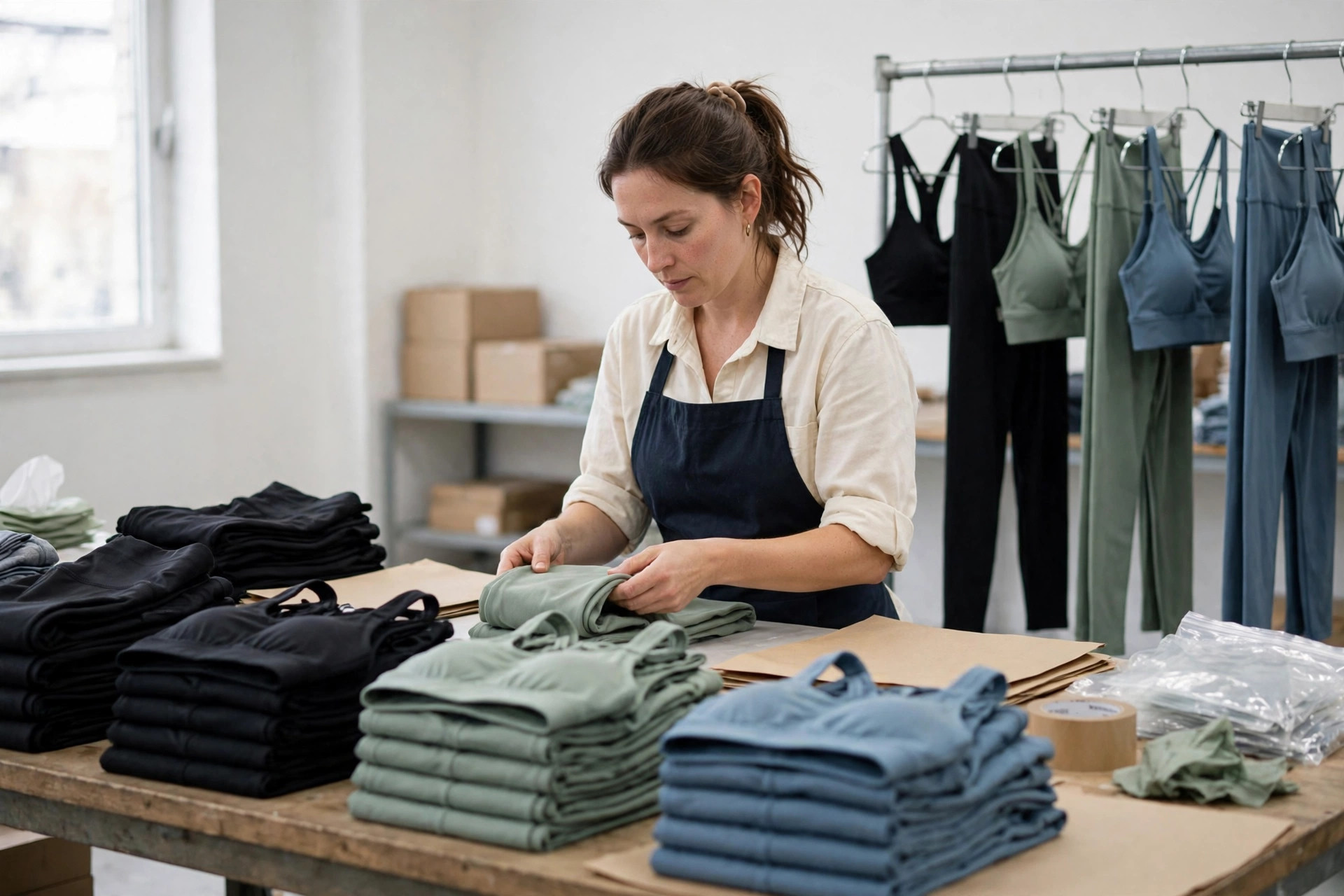
The practical numbers, since buyers ask: MOQ is 10 pieces per style, sizes can be mixed inside one style, and each colour is its own production run. Sampling runs 10-15 days. Bulk runs 20-30 days after deposit. Sample fee is $45-75 for general styles, complex styles quoted from a photo, and half the sample fee is refunded when the bulk order for that style goes over 20 pieces. Custom dyeing is about 100 metres per colour, and a lab dip, plainly, is a small dyed sample that shows the exact colour before bulk dyeing starts. Approve the lab dip, not the photo of it. For anyone checking who is on the other end of the thread: we are GUANGZHOU SHIWEI APPAREL CO., LTD., Building B, Jiaxing Industrial Park, No. 19 Huangang Er Road, Luogang Village, Baiyun District, Guangzhou, a women’s clothing factory of 11-50 people, and our SMETA 2-pillar audit was passed on 2026-08-03 by Benchmarks, reference ZAA600220151.
If I order 10 pieces per style at MOQ and mix sizes, will the see-through problem show up before bulk?
Only if you test the sample the way the customer will wear it. Order the sample, put it on a body, bend over in daylight, and squat. A folded swatch at 220 GSM can look solid and still go sheer at full hip stretch. The MOQ of 10 pieces is small enough that you can wear-test one piece properly before committing to bulk, and you should.
My waistband rolls when I sit, and the factory says the sewing is fine. Who is right?
Probably both. The sewing can be fine and the waistband can still roll, because roll is usually a pattern problem, not a stitching problem. A narrow elastic floating in a wide casing folds over when the wearer sits. Ask whether the casing was drafted for a wider elastic or a topstitch through it. If the answer is no, better sewing will not fix it.
The crotch seam burst after two weeks. Is that an AQL 2.5 failure on a 200-piece order?
Not necessarily. AQL 2.5 on 200 pieces means sampling 32 and allowing 1 defective, so a burst seam can pass inspection and still fail the customer. Burst complaints cluster at the crotch when there is no diamond gusset spreading squat stress. Ask whether the pattern has a gusset before you blame the operator. That is also why the first sample should be squatted in, hard, before the bulk run starts.
If I approve a lab dip and the bulk arrives 3-5% smaller after the first wash, is the factory at fault?
Check whether the cloth was pre-shrunk before blaming anyone. Un-pre-shrunk cloth can shrink 3-5% on first wash, and on a fitted legging that is the difference between snug and unwearable. Fabric should be inspected within 24 hours of arrival at the factory. If shrinkage was never raised at that stage, the conversation is about process, not blame. The time to settle it is at the fabric stage, while the roll is still on the table and nothing has been cut yet.
Can I get certified compression gear from a general women’s factory if I pay the $45-75 sample fee?
No. The sample fee buys you a sample of a ready style, not a certification. Certified technical compression gear and licensed branded performance yarns belong to specialist factories with the testing paperwork behind them. A general women’s factory can make a solid legging, but paying a sample fee does not turn it into a performance lab. What the fee does cover is the cutting, the sewing and the checking of that ready style, and nothing beyond it.
The last message I answered today was a buyer asking whether the sample could be sent again, because the first one looked fine on the table and she wanted to be sure. I told her to put it on and bend over in daylight first. She has not replied yet. Somewhere in a gym a customer is squatting in a legging that passed every test except the only one that mattered, and the return message is already typed, and I will read it tomorrow and know exactly which decision made it, and it will not be the sewing.


