
Why Do Wholesale Skirts Twist, Ride Uneven, or Sit Wrong After the First Wash When the Sample Sat Flat?


The short answer is that the sample was made slowly, by one or two people, with time to let fabric rest, and the bulk order was not. Wholesale skirts change after washing because the fabric was cut off-grain, because bias panels were hemmed before they hung, because a waistband was built with the wrong elastic or interfacing, or because the last 20% of the job got squeezed. At Shivette, MOQ is 10 pieces per style, samples take 10-15 days, and bulk takes 20-30 days after deposit, and most of the wash complaints I see come from that gap between the sample room and the line.
I am a merchandiser on the production floor in Guangzhou. I watch cutters, sewers and QC all day. I am not going to tell you the sample was a lie. It was real. It was just made under different conditions than the 200 pieces that followed it.
What actually happens between the sample and the bulk wash?
Start with the fabric. A sample is often cut from a small roll that has been sitting and relaxing for weeks. Bulk fabric arrives in a roll, gets spread on the table within a day or two, and gets cut while it is still tense. That tension releases in the first wash. If the grain line was not respected during spreading, the panel does not shrink evenly, it shrinks on a slant, and the skirt twists on the body.
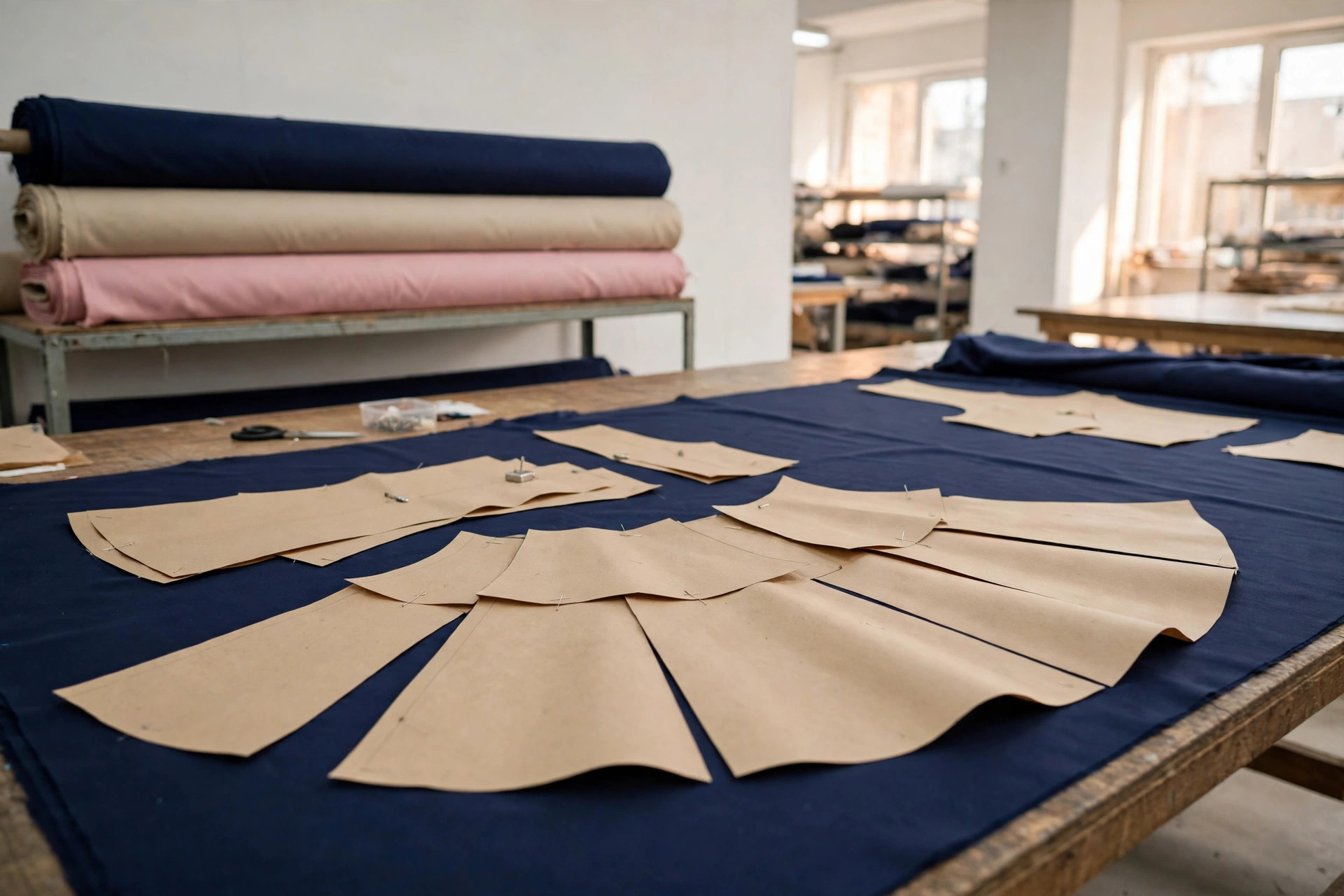
Grain line is the direction of the warp threads, the lengthwise threads in the fabric. It is the reference every pattern piece is aligned to. For the buyer, this means a skirt cut off-grain will hang crooked and the side seam will swing forward after washing even if the measurements on the table were correct. What we do is mark the grain line on every pattern piece and check the spread before the cutter starts, not after.
Then there is the hanging problem. Flared and circle skirts have bias edges, and bias edges stretch. A sample maker knows to let the skirt hang before hemming. On a bulk line, if the skirt goes from sewing machine to hemming machine to packing in one flow, the hem is cut while the bias is still relaxed. It looks flat on the table. Hang it in a shop for a week, or wash it once, and the hem waves. This is not a sewing fault. It is a sequencing fault, and it is ours to control.
Cutting loss matters here too. Plain fabric loses about 3% in cutting. Stripe matching costs 5-8%. Print matching can reach 10%. On wide flare lays, marker efficiency is poor, so fabric cost per piece jumps. That is a real cost the buyer pays for, and it is also why some factories try to squeeze the marker and end up with panels that are a few millimetres off grain. A few millimetres is enough to make a skirt twist.
Which failures show up most in wholesale skirts after washing?
The twisting side seam is the one I see most. The skirt looks fine flat. On the body, the side seam drifts toward the front, and after one wash it is clearly forward of where it should be. That is off-grain cutting, almost every time.
Waistband trouble comes second. A narrow elastic inside a wide waistband casing folds over in the wash. The casing is wider than the elastic, the elastic has room to roll, and it rolls. A rigid waistband without proper interfacing collapses and creases. Both look like cheap construction to the customer, and both are decided at the sample stage, not at the wash.
The invisible zip set into a curved side seam puckers if the seam is not stabilised before the zip goes in. The curve wants to move, the zip does not, and the fabric between them ripples. It is a small thing on the hanger and an obvious thing on the body.
Flat on the table means nothing.
Lining cut the same length as the shell pulls the hem up. The lining has less weight and less stretch than the shell, so when the shell relaxes in the wash, the lining holds the hem short. The skirt rides up at the front or the back, and the customer thinks the fit is wrong.
No wait. I should be fair here. Not every wash complaint is a construction fault. Some fabrics shrink more than the sample swatch suggested, and some customers wash hotter than the care label says. But the failures above are the ones we can control, and they are the ones that repeat across orders.
Where does the factory lose control on a wholesale skirt order?
The tail end. Buttonholes, buttons, thread ends, final pressing. That is the last 20% of the job, and when a line is rushing, that is the 20% that gets squeezed. Complaints roughly double when the tail end is compressed. A skirt can be perfectly sewn and still come back because a thread end was left at the hem or the pressing was skipped and the waistband went out creased.
Thread ends and the final pressing check take about 10 minutes per piece. Ten minutes sounds like a lot on a 200-piece order. It prevents a large share of returns, and returns cost more than ten minutes.
Fabric inspection is the other control point. Fabric must be inspected within 24 hours of arrival. If that is skipped, scrap risk goes up about 5x, because a shade variation or a weaving fault gets cut into 40 skirts before anyone sees it. We inspect on arrival, and we log it. When a buyer sends their own fabric, we ask them to inspect it before it ships to us, because once it is on our table, the clock is running.
That is where the clock goes.
Custom-dyed fabric needs about 100 metres per colour minimum, and dyeing normally takes 12-18 days. That is before cutting. If a buyer wants a colour match across three styles, that is three lab dips, and each one has to be approved before dyeing starts.
Lab dip is a small sample of the dyed fabric sent for approval before bulk dyeing. For the buyer, it means you see the actual colour on the actual fabric before 100 metres are committed. What we do is send the lab dip with the dye lot reference and wait for written approval, because a verbal yes on a photo is not an approval.
How does QC catch a skirt that will fail after washing?
It catches some of it. AQL 2.5 means a 200-piece batch samples 32 pieces, 1 defect is allowed, and 2 means rework. That is the standard we work to, and it is a statistical check, not a guarantee. AQL will catch a run of twisted side seams. It will not catch a hem that waves only after hanging for a week, because the skirt is not hanging for a week before it ships.
So we add checks that AQL does not cover. We hang flared skirts before hemming. We check grain line at the cutting table. We pull a finished skirt from each batch and wash it in-house before packing when the style has bias panels or a lined hem. It is not a lab test. It is a floor test, and it catches the obvious failures.
Grading is the other thing buyers ask about. Grading is the process of scaling a pattern from the base size to the other sizes in the range. For the buyer, it means the size medium is not just the size small made bigger, the proportions are adjusted. What we do is grade from the approved sample size and check the graded pattern against the measurement chart before cutting, because a grading error shows up as a skirt that sits wrong at the hip in one size only.
MOQ is 10 pieces per style. That is low enough that a buyer can test a style before committing to a full range. Most buyers start from the skirt and dress styles currently listed in the wholesale catalog and test one style first. Sample fee is $45-75 for regular styles, and complex styles are quoted from the photo. Half the sample fee is refunded when bulk per style exceeds 20 pieces. Samples take 10-15 days. Bulk takes 20-30 days after deposit.
MOQ means minimum order quantity, the smallest number of pieces we will run per style. For the buyer, it means you can order 10 pieces of a skirt, see how it sells, and reorder. What we do is hold the pattern and the fabric record for that style so a reorder matches the first run.
What should a buyer check before approving a wholesale skirt sample?
Wash it. Not the sample you were sent to approve, a duplicate. Wash it the way your customer will wash it, hang it for three days, and look at the side seam and the hem. If the side seam swings forward, the cutting was off-grain. If the hem waves, the bias was not allowed to hang. If the waistband rolls, the casing and elastic do not match.
Before you even get to construction, it helps to be clear on how skirt styles, lengths and fits are usually grouped for shoppers, because a flared skirt and a straight skirt fail in different places.
Then check the lining. Pull the hem of the shell and the lining apart. If they are cut the same length, ask for the lining to be shortened. It is a five-minute fix at the sample stage and a return at the bulk stage.
Check the zip. Run your thumb along the seam next to the invisible zip. If you can feel ripple, the seam was not stabilised.
This kind of factory is not a fit for buyers who need 3 pieces, real leather, or delivery inside a week. We run regular women’s skirts in wholesale quantities, and we are honest about what we do not do. We do not claim handmade beading, real fur, or real leather, because we do not make those.
Shivette is GUANGZHOU SHIWEI APPAREL CO., LTD., Building B, Jiaxing Industrial Park, No. 19 Huangang Er Road, Luogang Village, Baiyun District, Guangzhou, China. We are an 11-50 staff factory, and we hold a SMETA 2-pillar audit by Benchmarks dated 2026-08-03, reference ZAA600220151. Buyers who want to see the audit scope can ask for it before placing an order.
Questions buyers ask about wholesale skirts
If I order 10 pieces of one skirt style, will the wash test still be done on my batch?
Yes, on a 10-piece run we still pull one finished skirt and wash it in-house before packing when the style has bias panels or a lined hem. The batch is small, so the check is quick, and it is the same check we run on a 200-piece order. What changes is the sampling under AQL 2.5, which only applies at larger batch sizes. At 10 pieces we inspect every piece, because there is no statistical sample to take. The wash check is separate from the AQL inspection and runs on both small and large orders.
My sample sat flat but the 200-piece bulk order twisted at the side seam. What do I do with the batch?
Ask the factory to pull 32 pieces under AQL 2.5 and check the side seam against the grain line, because a twisted seam on a 200-piece batch usually means the spread was cut off-grain. If 2 or more pieces fail, the batch should be reworked, not shipped. The fix at the cutting stage is to re-mark the grain line and re-spread, which costs fabric. The fix after sewing is a recut of the affected panels, which costs more. Get the factory to show you the marker and the spread record before you accept the batch.
Can you match a custom colour across three skirt styles if I only need 10 pieces each?
Only if you accept the 100-metre per colour minimum for custom-dyed fabric, because the dye house will not run less. Ten pieces per style across three styles is 30 pieces, which is well under 100 metres, so you would be paying for fabric you do not use. The alternative is to pick from stock colours already in the factory, which avoids the dyeing lead time of 12-18 days and the minimum. If the colour is critical, order the 100 metres and use the balance on a later style.
What is the real lead time if I need 20 pieces per style and the fabric is custom-dyed?
Plan on 12-18 days for dyeing plus 20-30 days for bulk after deposit, so roughly 5-7 weeks from deposit to shipment, not counting the 10-15 days for the sample and lab dip approval. The dyeing time runs before cutting, so it does not overlap with the bulk window. If you need the skirts inside a month, custom dyeing will not work, and stock fabric is the only route. Confirm the lab dip in writing before the dye house starts, because a re-dip adds another cycle.
I had a buyer last month send back photos of a striped skirt, side seam forward by maybe two centimetres, and she asked me which wash cycle did it. I checked the marker sheet and the spread record, and the cutter had shifted the stripe match by one repeat to save fabric on a wide lay. The skirt passed AQL because the seam was straight. It just was not on grain. She is still deciding whether to reorder, and I have not told her yet that the same cutter is on the next style.


