
Why Do Wholesale Sweaters Come Back Thinner, Pilling, or Split at the Armhole When the Sample Felt Fine?


Because the sample was knitted at a different gauge than the bulk, and because the yarn that went into the bulk was bought on a different spec than the yarn in the sample. That’s the short answer. The longer answer is that neither of those things shows up on a purchase order unless somebody writes them down, and in most wholesale sweater orders nobody does. Our MOQ is 10 pieces per style, sampling runs 10-15 days, bulk runs 20-30 days after deposit, and a standard sample fee is $45-75 per piece with half refunded once a bulk order of that style passes 20 pieces. None of those numbers protect you from a gauge that was never specified. That’s the part buyers learn last.
Let me start where these things usually end, because that’s the honest place to start.
The cartons came back before anyone agreed what was wrong
Forty cartons. Cardigans, a lambswool blend, three colours. They went out in June and came back in August, and by the time they landed in the workshop nobody could agree on what had failed. The buyer said the sweaters felt thin. The sample they’d approved in March felt substantial, dense in the hand, and the bulk felt like a different garment that happened to share a colour. Our knitting manager held one up to the light and said the yarn was the same. The buyer said it wasn’t. Both of them were partly right, which is the worst kind of argument.
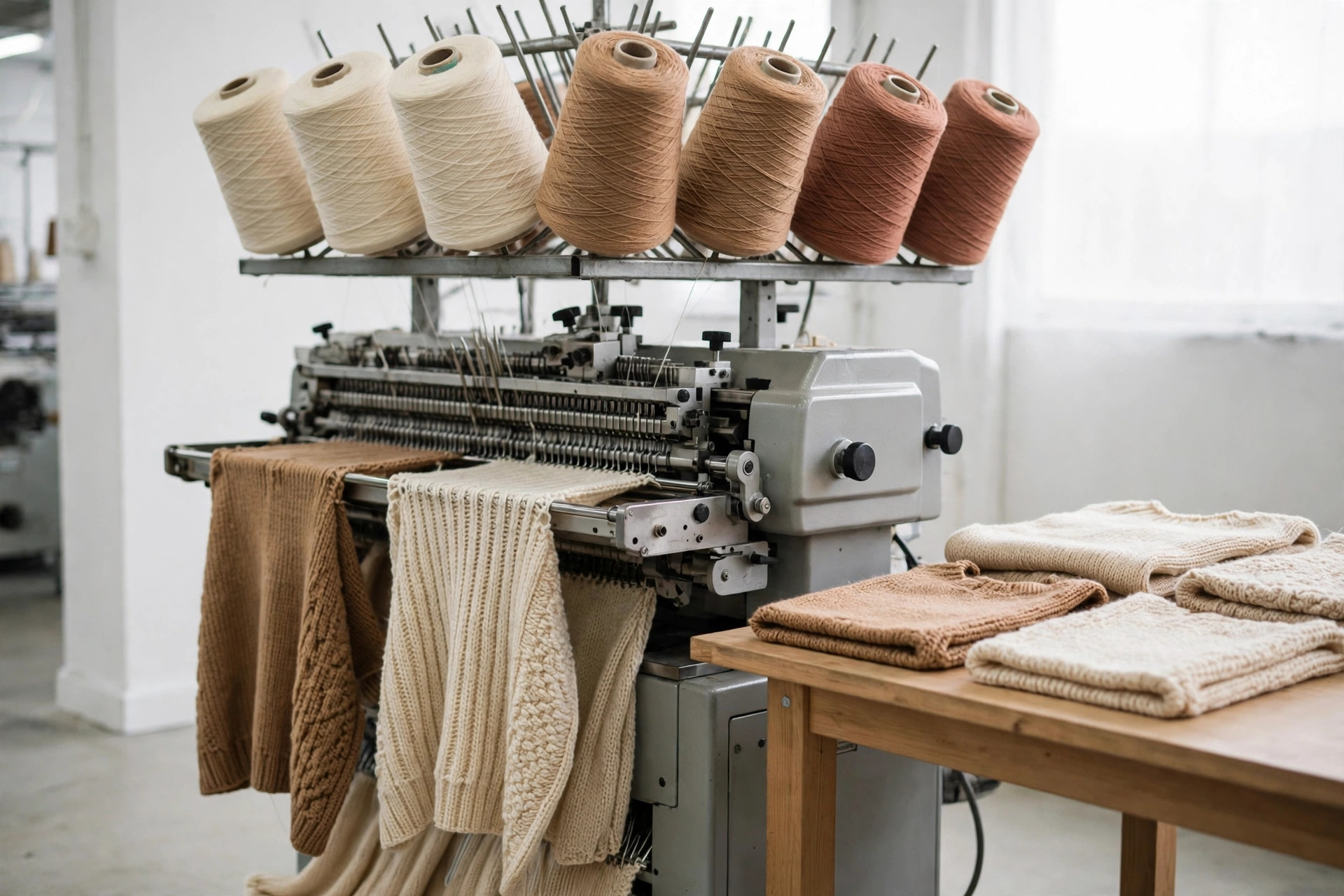
I spent two days on those cartons. Measured a dozen pieces flat, then again after they’d rested overnight, then again after a wash. The numbers moved. Not wildly, but consistently, the same direction, which is worse than random. A random error is a mistake. A consistent error is a decision somebody made and didn’t tell anyone about.
So I walked it backwards. That’s the only way these things come apart.
The seam that changed without anyone signing off
First thing I checked was the armholes, because armhole splits are the loudest symptom and the easiest to trace. The sample had linked armholes. Linking is joining knitted panels loop by loop instead of sewing through them, done on a linking machine, hand-guided, slow. It gives you a flat join with no ridge. The bulk had overlocked armholes. Overlocking is faster, it’s what you do when the run is behind, and it leaves a ridge along the join that catches and pulls. That ridge is where splits start.
Nobody decided to change it. That’s the thing. The sample room links because the sample room has time and a linker. The bulk line overlocked because the bulk line was chasing a date and the linker was on another style. If the buyer never asks how the seams will be closed in bulk, the method can quietly change between sample and bulk, and the first evidence you get is a returned carton with splits at the underarm.
Was that the whole failure? No. It was the visible one. The splits got the cartons sent back, but the splits weren’t why the sweater felt thin.
Nobody wrote the gauge down, so nobody could check it
Gauge is stitches per inch on the knitting machine, and it decides how dense the knit is. A chunky-looking sweater in a photo can be knitted coarse, around 5 gauge, or fine, around 12 gauge, and those are not the same garment. Different drape. Different yarn consumption. Different price, sometimes by a third. The photo looks identical because a photo doesn’t have a hand.
Our sample was knitted at 7 gauge. The bulk was knitted at 9. Both are plausible for that style. Both would pass a visual check against the photo. But 9 gauge uses finer yarn and produces a thinner panel, and a thinner panel drapes differently and feels lighter in the hand. The buyer approved a photo and a sample. Nobody wrote “7 gauge” on anything that reached the knitting floor.
I’ve started writing gauge on the sample tag itself, in marker, and photographing the tag next to the panel. It’s not a system. It’s a habit. But a habit that survives a staff change is worth more than a spec sheet nobody reads.
Here’s the part that stings. The gauge change wasn’t malicious. The knitter had a machine free at 9 and a date to hit. At 7 the machine was booked. Somebody made a reasonable call on a Tuesday and it cost forty cartons in August.
The yarn was decided before the first panel left the machine
Then I went further back, to the yarn, because the hand-feel complaint kept pointing there and I didn’t want it to.
Pilling and thinness are decided when the yarn is bought, not when the sweater is sewn. Short-staple, low-twist yarn pills fast no matter how careful the knitting is. Anti-pilling behaviour is a yarn specification, full stop. Once the panels are knitted, no finishing step in a small factory truly fixes a yarn that was bought cheap. You can shave pills off the surface. They come back. You can wash and press. It buys a week.
The sample yarn was a longer-staple lot with more twist. The bulk yarn was a cheaper lot from a different supplier, bought when the original lot ran short. Same count on paper. Different behaviour in the hand. The two lots matched under workshop light, which is exactly the trap.
Which brings up yarn lot, meaning one dyeing batch of yarn. Body panels and sleeves knitted from two different lots can match under fluorescent light and split visibly in daylight. That’s the knit version of a fabric dye-lot problem, and it’s why one style in one colour should be knitted from one yarn lot. A 10-piece order split across three colours is three separate small yarn problems, not one. The knit side of that range sits among the sweater and dress styles currently listed in the wholesale catalog. Each colour is knitted as its own run, and each run needs its own lot discipline. Buyers who order ten pieces in three colours to “test the style” are running three experiments and calling it one.
The panels lied about their measurements, and we believed them
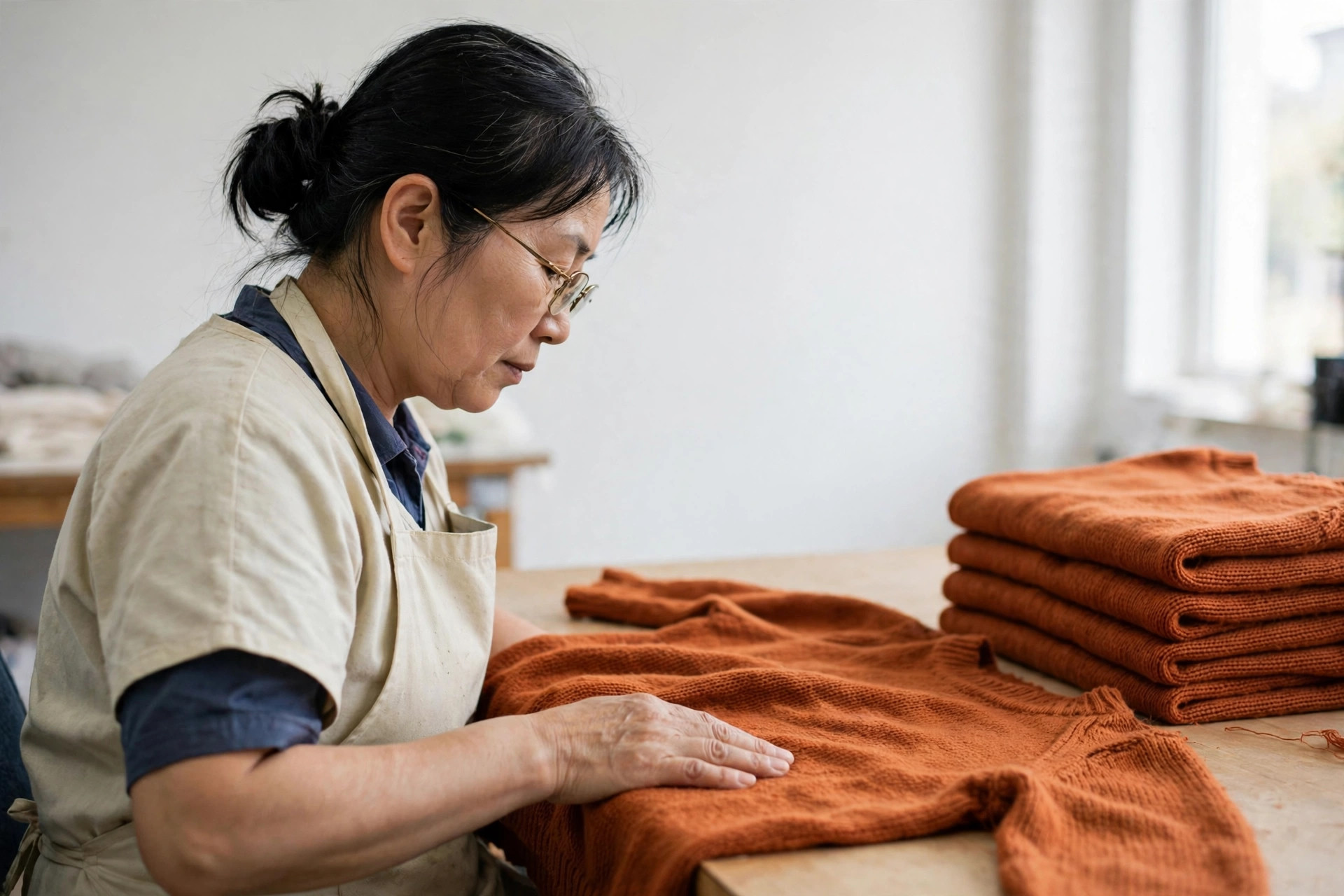
Last stop, the measuring table. Panels come off the machine stretched. A sweater measured straight away reads longer and narrower than it will after resting and a wash. Panels need to rest flat before measuring and before linking, otherwise every size in the run drifts the same wrong way.
Ours didn’t rest long enough. The bulk run was measured warm off the machine, linked warm, and packed. By the time the cartons came back, the pieces had relaxed into a length nobody had approved. Not a big drift. Two centimetres, maybe a bit more on the larger sizes. Enough that the buyer’s fit check failed on every size at once, which is the signature of a rest-time problem rather than a cutting problem.
No wait. I should be careful there. Some of that drift was the gauge change, not the rest time. A 9-gauge panel relaxes differently from a 7-gauge panel. I can’t cleanly separate the two after the fact, and that’s part of the point. When three things go wrong in the same direction, you can’t attribute the damage afterwards. You can only fix the process going forward.
What I can and can’t see from the yarn side
I deal with yarn suppliers and knitting panels. I can tell you what lot a panel came from, what gauge it was knitted at, how long it rested, and how the seam was closed. I can’t tell you whether the buyer’s fit model would have approved the 7-gauge version either. That part I can’t judge from the yarn side. Some of the samples we send out are approved because they’re the only option in front of the buyer that week, and no amount of gauge discipline fixes a brief that was never clear.
What I can say is that the failures above share one shape. Every one of them was a decision made on the factory floor, reasonably, by someone with a date to hit, that never reached the buyer because nobody had written the original spec down. Gauge. Yarn lot. Seam method. Rest time. Four things, none of them on the purchase order, all of them deciding what the sweater feels like in the hand.
For context on where this sits: we’re GUANGZHOU SHIWEI APPAREL CO., LTD., Building B, Jiaxing Industrial Park, No. 19 Huangang Er Road, Luogang Village, Baiyun District, Guangzhou, China. 11-50 staff. SMETA 2-pillar audit by Benchmarks passed 2026-08-03, reference ZAA600220151. Yarn and fabric run roughly 45-55% of a garment’s cost, which is why the yarn decision outranks almost everything downstream. Prices on yarn and fabric adjust around March and September by roughly 5-12%, so quotes hold about 30 days. That March and September rhythm is also why how the seasons move a women’s clothing buying calendar matters more for knits than for a plain woven dress. And the honest limits: if a buyer needs true cashmere, real fur or genuine leather, we cannot do it. Fur cannot be exported by us, and leather only as PU or faux leather. A sweater order under 10 pieces per style isn’t a fit for this factory either.
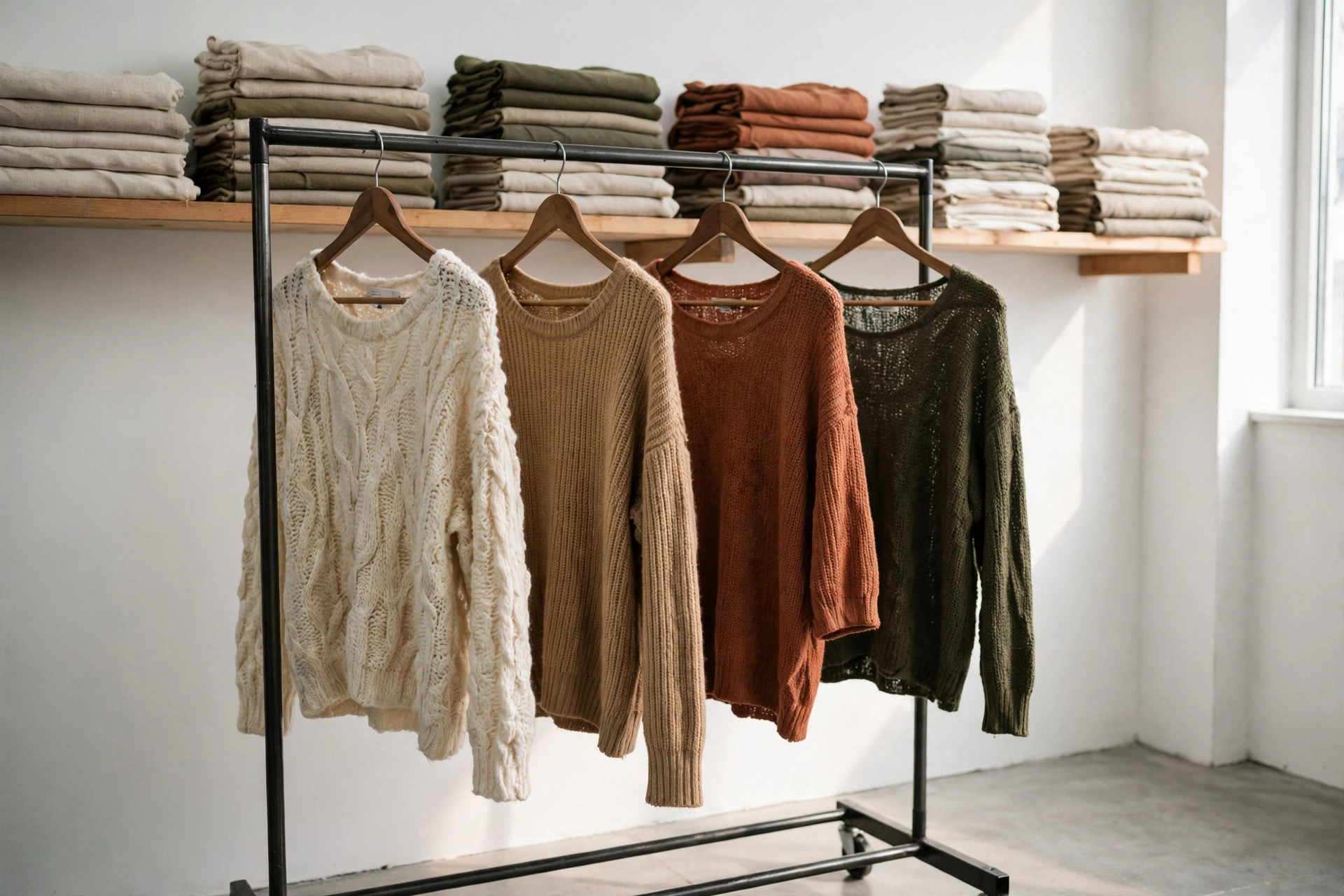
We paid $45-75 for a sample and the bulk doesn’t match it — what actually went wrong?
Usually the gauge was never written down. The sample was knitted at one gauge, the bulk at another, and both matched the photo, so nobody caught it until the hand-feel complaint. In our case it was 7 gauge against 9. The sample fee buys you a physical reference, but only if the spec travels with it. Ask for the gauge in writing on the sample tag, and photograph the tag next to the panel. If the factory can’t tell you the gauge of your own sample, that’s the answer to your question already.
Sampling took 10-15 days and bulk took 20-30 after deposit — why did the seams change in that window?
Because the sample room and the bulk line are different rooms with different pressures. The sample room links armholes because it has a linker and time. The bulk line overlocked because the linker was booked and the date was close. Nobody signed off on the change. It just happened between the two stages. Ask, in writing, how the seams will be closed in bulk, and compare it to the sample. If the answer is “same as sample,” get the method named. Linked and overlocked are not the same join and they don’t fail the same way.
I ordered 10 pieces per style across three colours — why do the colours behave differently?
Because each colour is knitted as its own run, and each run is its own small yarn problem. Three colours means three yarn lots, three chances of a lot split between body and sleeves, three sets of resting and measuring. A 10-piece order in three colours isn’t one test, it’s three. If one colour pills and the others don’t, that’s not the style failing, that’s one lot failing. Keep one style in one colour on one yarn lot, and treat each colour as a separate experiment with its own result.
The quote held for 30 days and then moved — is that normal with yarn at 45-55% of cost?
Normal, yes. Pleasant, no. Yarn and fabric prices adjust around March and September by roughly 5-12%, and since yarn is nearly half the garment’s cost, a 10% yarn move is a real number on the invoice. A 30-day hold is about as long as anyone can honestly offer. If a quote is held for six months, somebody is either absorbing a risk they haven’t priced or planning to change the yarn lot when the price moves. Ask which. The answer tells you more than the quote does.
I still have one of the returned cardigans on the shelf behind my desk. 9 gauge, overlocked armholes, a sleeve from a different lot than the body. Under the workshop light it looks fine. I take it out to the window sometimes when a buyer sends a photo and asks whether we can match it, and I hold it up in daylight and think about the Tuesday somebody made a reasonable call.