
Why Do Wholesale Jumpsuits Get Returned for Fit When the Dress From the Same Factory Fits Fine?


Because a jumpsuit is not a dress with legs sewn on, and the difference shows up in returns. The dress from that factory fits fine because a dress asks for two measurements to behave, bust and hip, and the waist seam quietly forgives the rest. A jumpsuit asks for a third one nobody wrote on the spec sheet: torso length, the distance from shoulder to crotch. Get that wrong and the same size run that sold dresses without a complaint comes back as a wall of returns, and the customer can’t keep the top half to salvage the sale. We build both garments in our own workshop in Baiyun District, at MOQ 10 pieces per style, sizes mixed inside a style, and I’ll tell you straight: most of the jumpsuit returns I’ve seen traced back to a factory that graded the widths and never touched the length. Ours included, once.
The measurement nobody writes down
Let me define grading before I lean on it, because it’s the whole article. Grading is how a factory turns one base size into the rest of the run: you take the sample that fits the fit model and step each measurement up or down by a fixed amount per size. Our base size S is bust 86cm, waist 68cm, hip 90cm, and each step is plus or minus 4cm. That rule works beautifully on a dress. On a jumpsuit it’s only half the job.
Here’s the mechanical reason. A dress has a waist seam, and that seam is a hinge. If the bodice runs a little short, the skirt still hangs; if the hip runs a little wide, the waist seam absorbs it. A jumpsuit has no hinge. The bodice and the trouser are one continuous piece of cloth from shoulder to hem, so every error has nowhere to go but into the garment’s behaviour on a body. Step the widths by 4cm and leave body length and rise untouched, and you get a size run where the M fits the model and the XL cannot sit down. I’ve watched this happen in our own sample room. The pattern was graded by the book, the measurements matched the spec sheet to the millimetre, and the XL still pulled at the crotch the moment the fit model took a chair. The spec sheet was the problem, not the sewing.
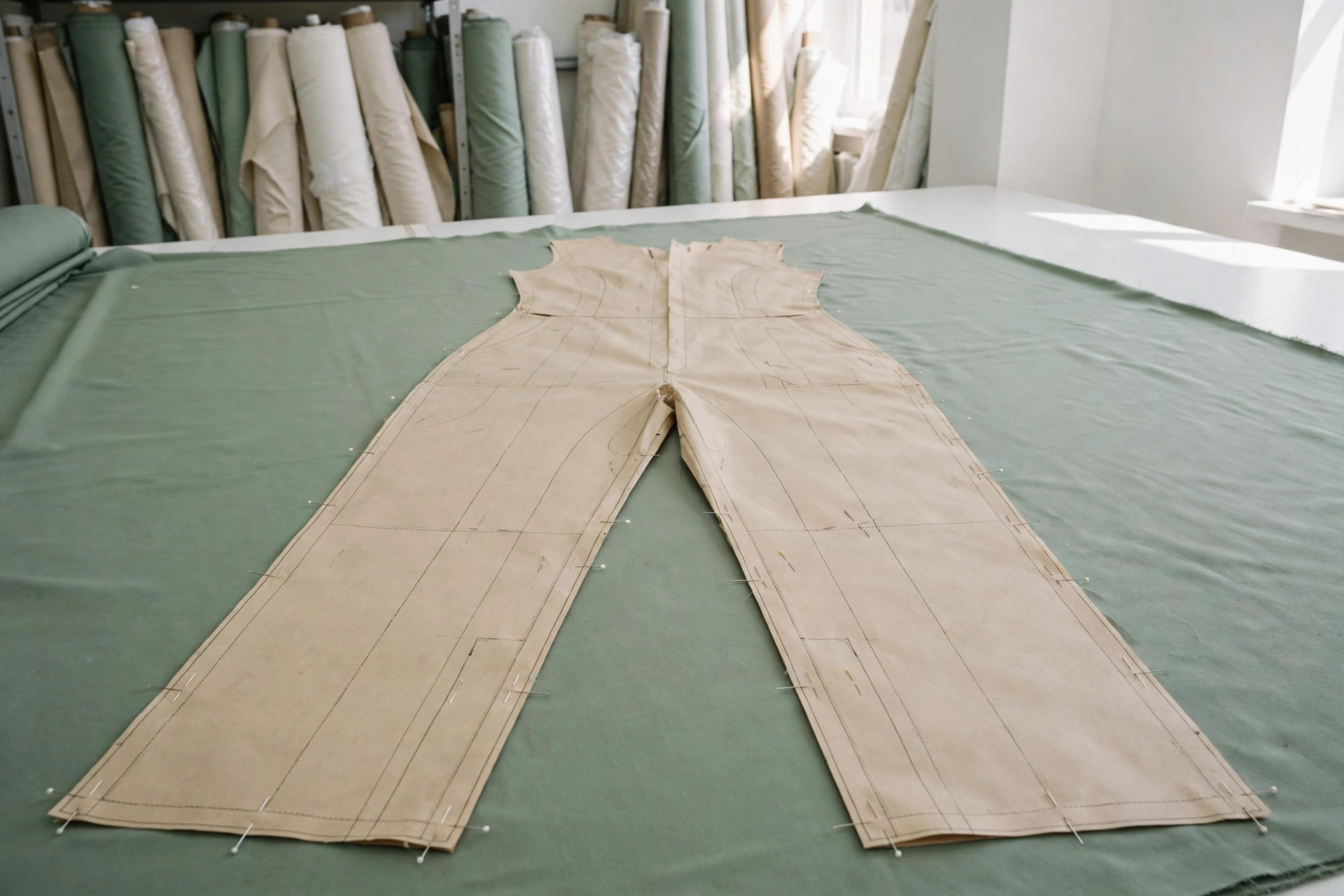
So the first cost line in jumpsuit returns isn’t fabric or labour. It’s a pattern room that treats length as a constant. Fixing it means grading torso length and rise as their own stepped values, then checking every size seated, not just standing. That’s pattern work you pay for once, and it’s cheaper than the returns.
Why does the quote look like a two-piece set?
Then there’s yardage, which is where buyers usually decide the factory padded the quote. One jumpsuit consumes roughly a top plus a trouser in a single continuous lay. That’s the honest way to think about it: you’re buying how two-piece sets are put together for shoppers worth of cloth, cut as one garment. Wide-leg pieces cannot nest the way skirt panels do, because a skirt panel is a shape that curves away from itself and leaves room for the next one on the marker, while a wide trouser leg is a long straight-ish column that mostly refuses to share space. Marker efficiency drops, and the fabric cost lands closer to a two-piece set than to a dress. A dress cost structure runs roughly fabric 45-55%, sewing labour 20-25%, trims 8-10%. A jumpsuit pushes the fabric share toward the top of that range or past it, and the labour share climbs too because there’s more seams and a long closure. If you benchmark our jumpsuit quote against a dress quote from the same line, the gap is real cloth, not padding. I’ve had buyers walk over exactly that gap. Some come back after their first production run elsewhere. Some don’t, and that’s fair.
Fabric timing makes that gap move, too. Cloth prices in this trade adjust around March and September, usually 5-12% at a time, which is why an honest quote here carries about 30 days of validity instead of a promise that lasts the season. On a dress, a 10% fabric rise hurts. On a jumpsuit, where the fabric share already sits at the top of the range, the same rise lands on a bigger base and eats the margin from both ends. A buyer who holds a spring jumpsuit quote until autumn and expects the spring number is not being cheated when the number changes. The cloth changed first.
The zip has to cross the waist seam
The long closure is the third thing, and it’s the one that bites in bulk. A back zip of about 55-60cm has to cross the waist seam dead level. On the sample, one seamstress sews it slowly, pins it, presses it, and it’s clean. On the line, the same seam is sewn at speed by whoever is at that station, and the zip crossing is where bulk orders wave or pucker even when the sample came back clean. A button-front style multiplies the problem: more buttons, more placket work, more places for the front edge to ripple. This is a factory fault when it happens, and I won’t dress it up. The fix is a construction call, not a sewing call: interface the waist seam where the zip crosses, or move the closure so it doesn’t cross the seam at all. Either way it costs a little and saves a lot, and a factory that won’t have that conversation before bulk is telling you something.
No wait. I should be fairer than that. Not every wavy zip crossing is the factory’s fault. If the buyer approves a sample sewn by the sample room’s most careful hands and never asks to see a line-sewn piece, the factory has done what was asked. The fault is shared, and the fix is a pre-production piece off the actual line, not another sample-room sample. Ask for it. We’ll sew it.
Nobody tests it sitting down
Sitting is the real fit test, and it’s the one almost nobody runs. A jumpsuit that stands fine in front of a mirror pulls at the shoulder or the crotch seam when the wearer sits. Standing-only sample checks pass stock that returns, every time. The return rate on a one-piece is total, remember: the customer can’t keep the top half and send back the legs. So the fit session has to include a chair, a car seat, a stair, and a reach across a table. If your factory’s fit model only stands and turns, you’re approving half a garment.
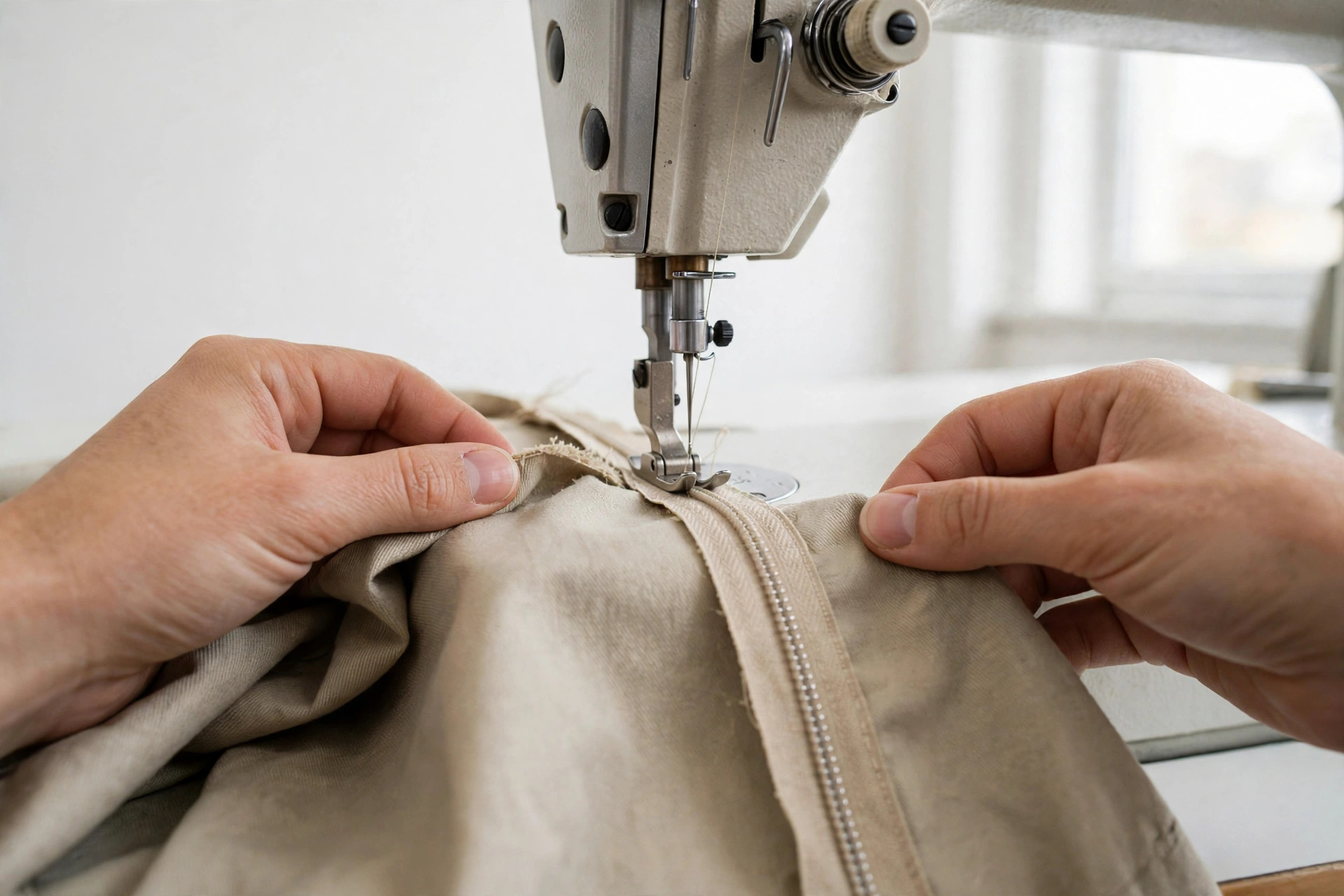
Colour and shrinkage behave like a set, too, and this is where a jumpsuit punishes sloppy cutting in a way a dress doesn’t. Bodice and legs cut from different rolls, or from rolls that shrink at different rates, make one garment look like two garments after the first wash. Un-preshrunk fabric can shrink 3-5% on first wash, and 3% on a 60cm torso is nearly 2cm of length gone, which is exactly the margin that decides whether the XL can sit down. Colourfastness grade 4 on the grey scale is the contract line, and on a jumpsuit I’d want bodice and leg panels from the same dye lot, tested together, not separately. Each colour is patterned and cut separately in our workshop for this reason. It costs a little marker efficiency. It saves the garment.
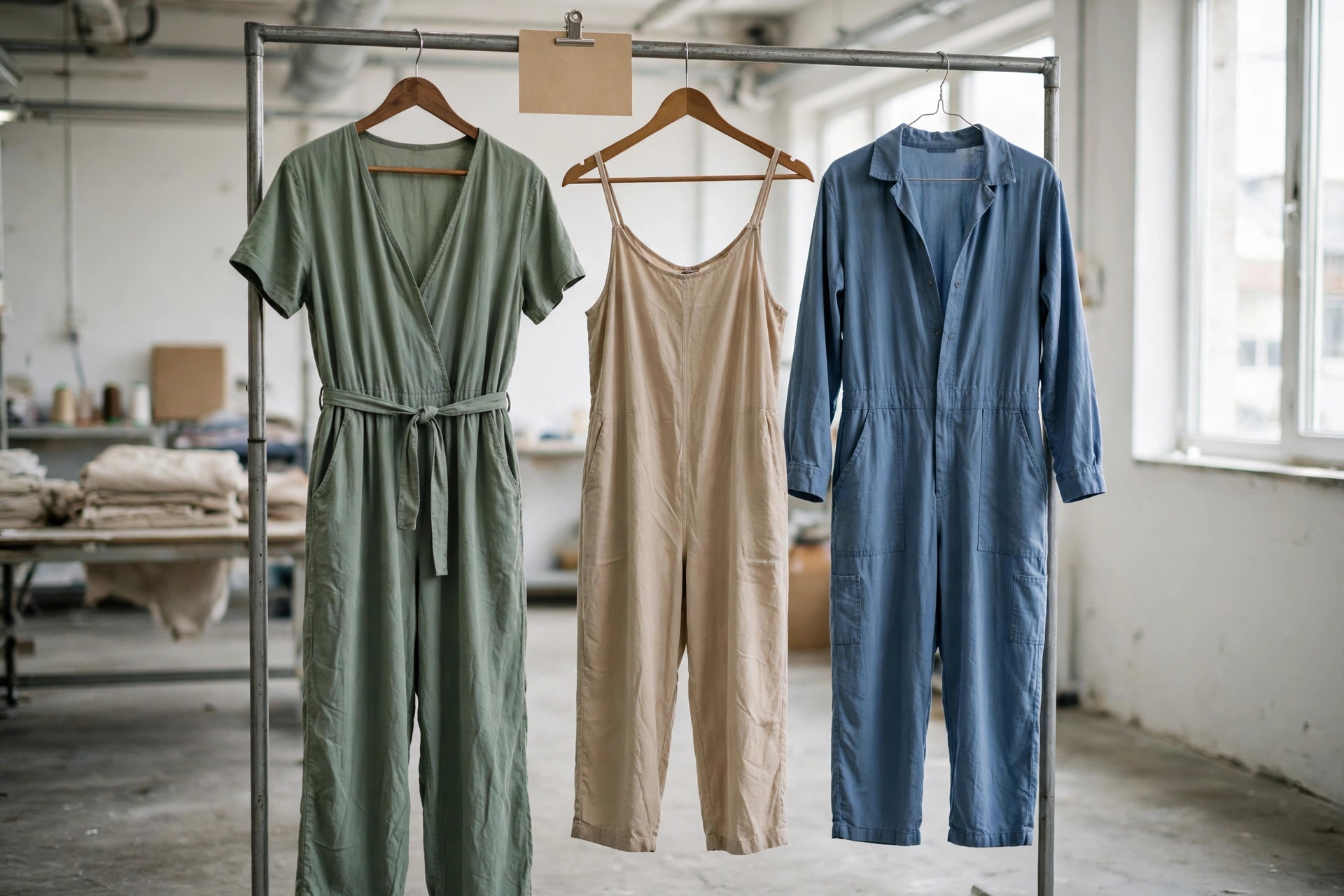
There is a cutting room habit behind that rule, and buyers rarely hear it explained. Every colour gets its own lay on the cutting table, its own marker, its own first-piece check, whether the colour runs 200 pieces or 10. A five-colour jumpsuit order is five small cutting jobs wearing one order number. The two ends of every lay waste the same amount of cloth no matter how many pieces sit between them, so a short lay spreads that fixed waste across fewer garments and the per-piece cloth cost climbs. That is arithmetic, not a surcharge, and it is also why mixing colours inside a style is easy to promise and slower to cut than it sounds.
What do the fixes actually cost?
Now the money, since this is meant to be a cost breakdown. The returns you’re trying to avoid come from four places, and only one of them is visible on a quote sheet. Pattern work for length and rise grading is a one-time cost per style, and it’s the cheapest line here. Pre-production line sewing, one piece off the actual line before bulk, costs you a piece and a day. The long closure’s construction fix, interfacing or a moved seam, is pennies per unit. Same-dye-lot cutting and a wash test on the actual fabric is a small upcharge on fabric and a few days on the calendar. Sampling runs 10-15 days and bulk 20-30 days after deposit, so none of this fits in a rush order, and that’s the honest trade. The expensive line is the one you don’t pay: returns on a one-piece, where the customer keeps nothing and tells everyone.
Where does custom fabric fit? Custom-dyed fabric needs about 100 metres per colour, so if you’re planning a jumpsuit program in a signature colour, that’s the floor before the dye house will talk to you. Sample fees run $45-75 for a regular style, complex styles quoted from the photo, and half the sample fee is refunded when a style goes to bulk over 20 pieces. The styles that can carry that pattern work today sit in the jumpsuit and dress styles currently listed in the wholesale catalog, and the list is shorter than the full range for a reason. None of that changes because it’s a jumpsuit. The pattern work does.
And I’ll say the honest line about when we’re the wrong choice. If you need a single sample tomorrow, we’re wrong for you; sampling takes 10-15 days and I won’t pretend otherwise. If you want genuine leather jumpsuits, we’re wrong too; that’s a different trade with different machines and different people, and I’d rather point you at it than take the order. We’re GUANGZHOU SHIWEI APPAREL CO., LTD., a small workshop at Building B, Jiaxing Industrial Park, No. 19 Huangang Er Road, Luogang Village, Baiyun District, Guangzhou, China, 11-50 staff, SMETA 2-pillar audit by Benchmarks passed 2026-08-03, ref ZAA600220151, and small means we say no to things we can’t do well.
So why does the dress from the same factory fit fine?
Because the dress was graded on the measurements the spec sheet asked for, and the spec sheet was right for a dress. The jumpsuit was graded on the same sheet, and the sheet was missing a line. That’s the whole answer, and it’s a factory answer, not a customer answer. The dress fit because a dress forgives; the jumpsuit returned because a jumpsuit doesn’t.
Does a higher MOQ fix the fit?
No, and I wish it did. MOQ 10 pieces per style with sizes mixed inside a style is enough to run a proper seated fit check on every size, and that’s the fix, not volume. A 500-piece order graded on widths alone returns at the same rate as a 50-piece order. Volume buys you price, not pattern sense. The fix sits on the pattern sheet, not on the purchase order.
What should I ask a factory before I place a jumpsuit order?
Three questions. Ask how they grade torso length and rise, and listen for a number, not a nod. Ask to see a piece sewn on the actual line before bulk, not another sample-room sample. Ask whether bodice and legs come from the same dye lot and whether the fabric was wash-tested for shrinkage. If the answers are vague, the returns are already in the box.
I had a buyer last season, a dress customer of ours for two years, send back a jumpsuit sample with a note that said the M was perfect and the L pulled at the crotch when she sat. She was right, and our grading sheet was wrong, and we’re re-cutting the block now. She hasn’t placed the bulk order yet. I don’t know if she will.


